
You have had the pimples under control for a long time, but the traces remain: red or brown spots, small dents, skin that looks uneven in the bathroom mirror. The surprising answer: most of these “scars” are not scars at all. They often fade on their own – if you do the right thing (and leave the wrong thing). How to find out in ten seconds what you are dealing with, and why your bathroom mirror deceives you mercilessly, you will read here.
The honest answer from a beautician, up front: Flat spots (red or brown) are pigment or vessel reactions and mainly need time, sun protection and the right active ingredients. True acne scars are indentations. They arise when collagen is missing and can only be improved by building collagen, for example with microneedling. They rarely disappear completely, but they very often become visibly better.
✨ Unsure what you have? We will look at it for free – and tell you honestly what is worth it.
Contents
Three kinds of “pimple marks” – and which one you have
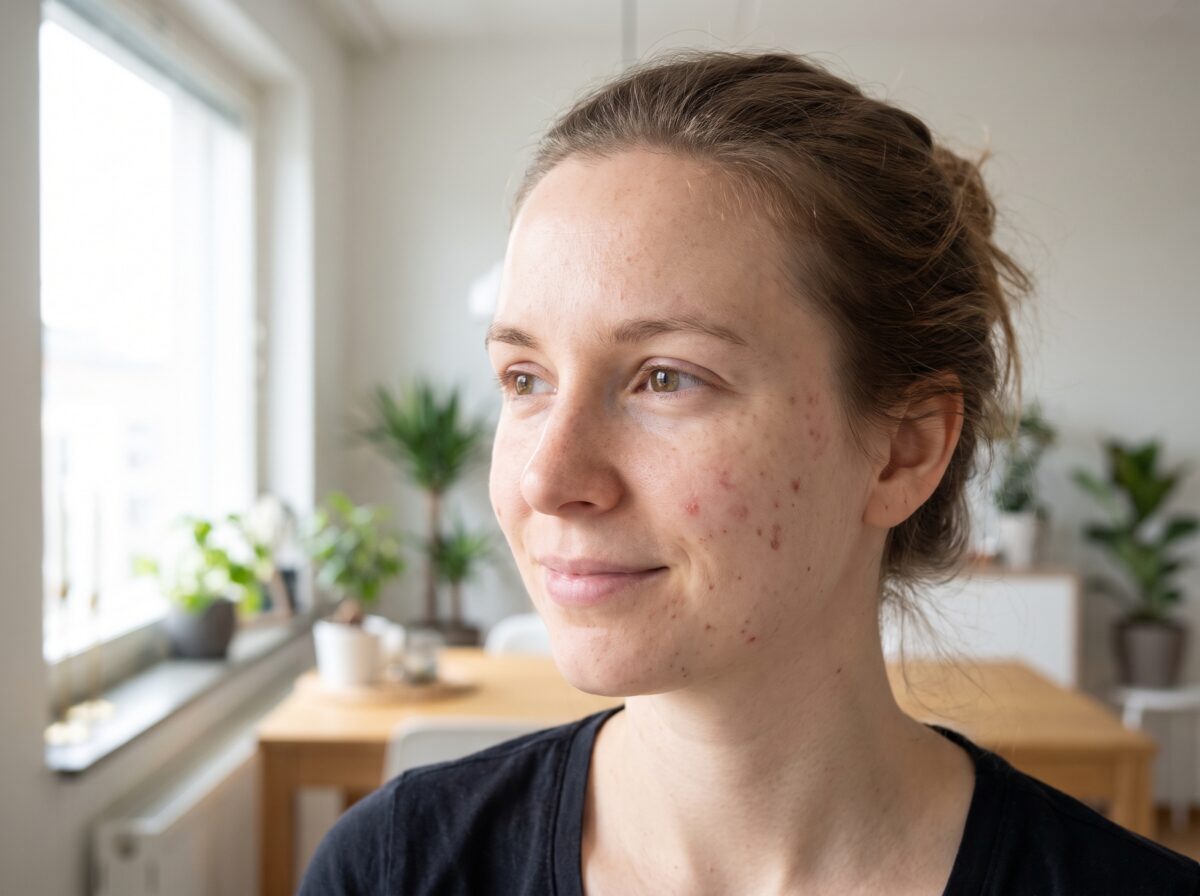
An important distinction
1. Red spots (post-inflammatory erythema): The skin was inflamed, the tiny blood vessels are dilated. The mark is flat and reddish to purple.
2. Brown spots (post-inflammatory hyperpigmentation): After the inflammation, the skin produced too much pigment. Flat, brown, especially common in darker skin types.
3. True scars (atrophic scars): Dents or small craters because too little collagen was formed during healing. Here you can feel an indentation with your finger.
🔴 Red = vessels · 🟤 Brown = pigment · 🕳️ Dent = scar
This matters because each kind is treated differently. A treatment for brown spots will not stop a dent, and microneedling will not turn a red spot into smooth skin.
The 10-second test (glass and stretch)
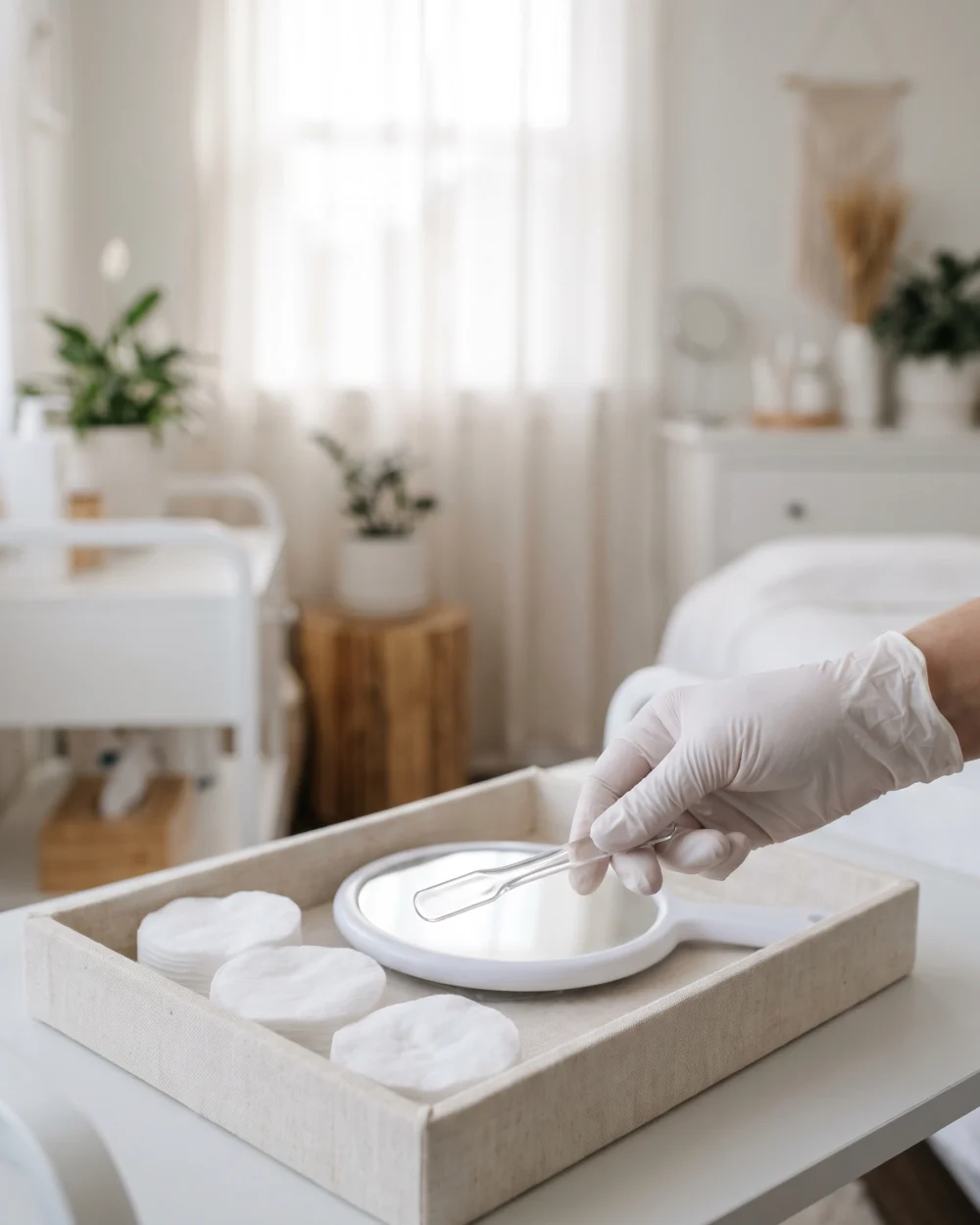
Test 1: The glass test
Dermatologists and beauticians use this, it is called diascopy. Press a clean, transparent glass (or a glass spatula) lightly on the spot and look through the glass.
Does the spot turn pale? Then it is a red spot (vessels). The blood is pushed away.
Does the colour stay? Then it is pigment, so a brown spot. Pigment cannot be pressed away.
🔍 Pale = red · 🟤 Stays = brown · ⏱ 10 seconds
Test 2: The stretch test
For true dents: gently pull the skin around the dent apart with two fingers.
Does the dent become shallower or disappear? Then it is rather mild and usually responds well to treatment.
Does it stay even when stretched? Then it sits deeper. That is not hopeless, but you will need patience and usually several treatments. Very narrow, deep “icepick” scars are the most difficult form and are often additionally treated medically.
👉 Shallower = mild · 👉 Stays = deeper · 🚫 Do not squeeze
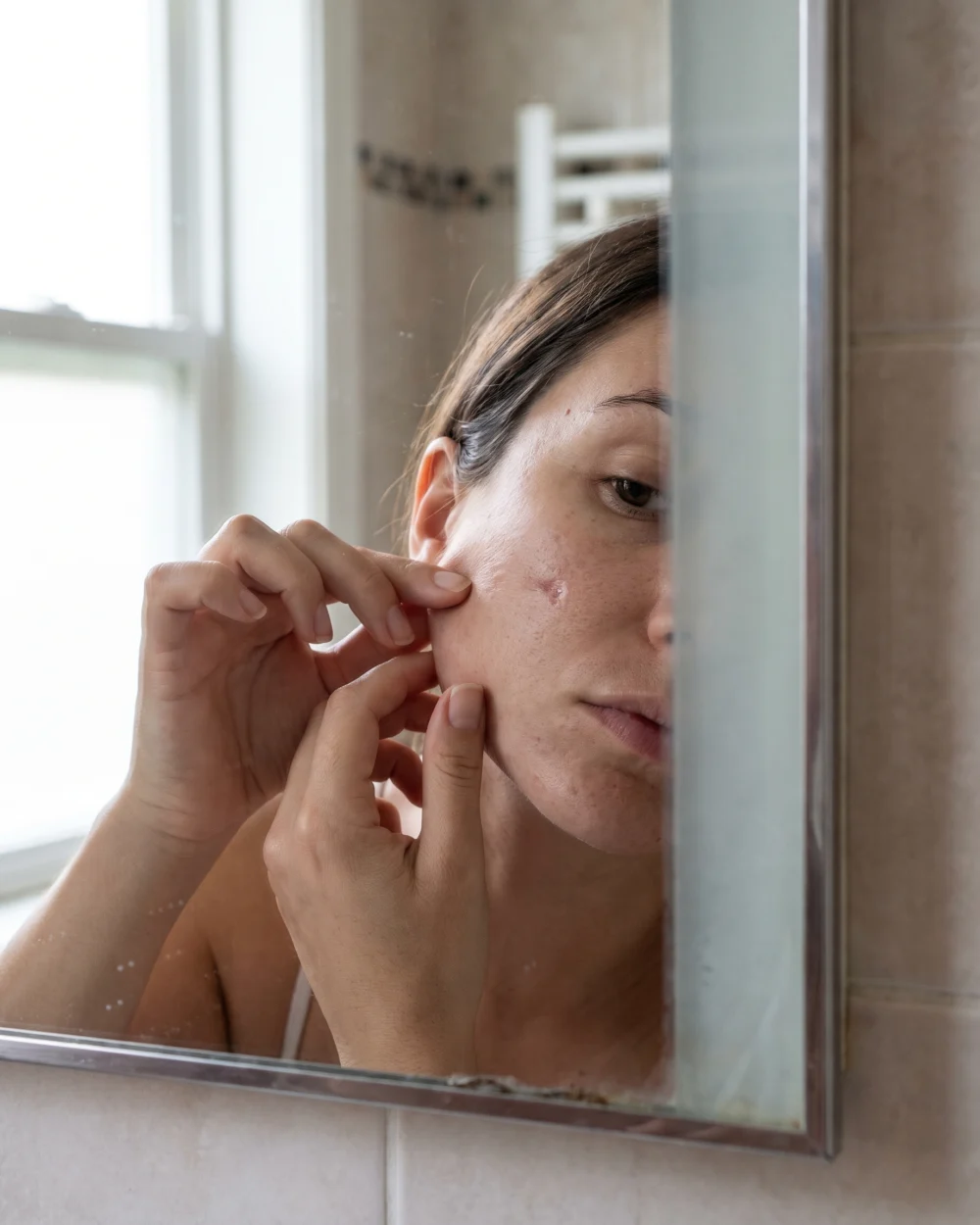
Why your mirror lies
Here is a trick almost nobody mentions: the light decides how deep a scar looks. The spotlight above the bathroom mirror comes from above at an angle and casts tiny shadows into every unevenness. This is called raking light. The same skin looks much more uneven there than at a window or outdoors.
How to judge progress fairly
Take a photo every four weeks of the same spot: same time of day, at a window, without flash, same distance. Only this way will you see whether something is really changing, and you will not get frustrated by the mirror lighting.
How long does it take for spots to fade?
There is no fixed number, but a rough guide: red spots often fade in a few months, brown ones frequently take longer, sometimes up to a year or more. The factor that can prolong everything is sun: UV light darkens pigment and makes the spots more stubborn. Anyone who does not use sun protection is working against the wind. More on this in the article SPF 30 vs. 50 and at removing pigment spots.
What makes pimple marks worse
The most common mistakes
Squeezing and scratching: The longer and stronger an inflammation, the higher the risk of scars and spots. This is the biggest single factor you can influence. More at removing blackheads safely.
Sun without protection: Brown spots get darker, red ones last longer.
Care that is too aggressive: Irritation creates new inflammation, and that creates new spots.
Treatment too early: On acutely inflamed skin we do not do microneedling. The acne has to be calm first.
☀️ SPF every day · ✋ Do not squeeze · 🧘 Calm the skin
What really helps
| Problem | What helps | Realistic expectation |
|---|---|---|
| Red spots | Sun protection, gentle care, patience; stubborn cases: vascular laser at the dermatologist | Often fade within months |
| Brown spots | Sun protection, azelaic acid, niacinamide, vitamin C, retinol, chemical peel | Noticeably lighter after weeks to months |
| Flat, mild dents | Microneedling (collagen building), partly combined with a peel | Visibly smoother after several sessions |
| Deep icepick scars | Often combined medical procedures | Clear improvement possible, rarely complete |
Important: when choosing active ingredients, less is more. Anyone who uses three strong actives at once mainly gets one thing: irritated skin. Start with one that your skin gets to know.
When a studio is worth it
At Mirela The Facialist we treat both. For brown or red pimple marks we use superficial peels (for example with fruit acids) that speed up renewal. For true dents we rely on microneedling with the Dermapen. Both can be combined if your skin needs it. You will find details on our page acne scar removal. More about suitable peels is in the article Which peels help with acne scars.
And a frequently overlooked point: if you have taken isotretinoin in recent months, definitely discuss with your doctor how long you should wait before a scar treatment. If you want to calm the skin after a treatment, you will find a gentle complement in light therapy.
How to find out what your skin really needs
The glass and stretch tests are a good start but do not replace an analysis. In the free skin analysis we classify your marks properly, tell you honestly what is worth it and plan the order.
1
Book an appointment
Book online – your skin analysis is completely free.
2
Skin analysis
We assess skin type, hydration, pores & pigmentation.
3
Get your plan
You get an honest recommendation – no obligation.

✦ 100 % free
Your free skin analysis in Munich
Take the first step towards a more even complexion. Together we find out whether your case needs time, care or treatment.
- Professional assessment of your skin type
- Honest, personal treatment recommendation
- Tips for your home care
- No obligation & no pressure to buy
FAQ about pimple marks and acne scars
Do pimple marks go away on their own?
Flat red and brown spots usually fade with time, especially with consistent sun protection. True dents do not disappear on their own.
How long does it take for them to disappear?
That is individual. Red spots often need a few months, brown ones frequently longer, with sun and darker skin sometimes over a year.
Can acne scars be removed completely?
Deep scar tissue can rarely be removed 100 %. But dents can become visibly smoother and less noticeable.
Does microneedling help with active acne?
No. With inflamed pimples we do not do microneedling. First we calm the acne, then we turn to the scars.
Do I need sun protection when it is cloudy?
Yes. UV radiation also comes through clouds and can make brown spots darker and more stubborn.