Gua sha promises a defined jawline, less puffiness and a glow like after a facial – with a simple stone and five minutes a day. Sounds too good to be true? Partly it is actually true. But only if you know what the stone can and cannot do. And above all: how to use it correctly, because this is exactly where most people make the decisive mistake.
The honest answer up front: gua sha can reduce puffiness in the short term, boost circulation and relax you. Lasting lifting or tightening is not scientifically proven. With the right technique it is a lovely care routine, not a replacement for treatments.
When you read in a moment how to use gua sha step by step and which five mistakes to avoid, you will look at the stone with different eyes.
✨ Curious what makes sense for your skin? We analyse it for free – no obligation.
Contents
What gua sha can really do
The reality check
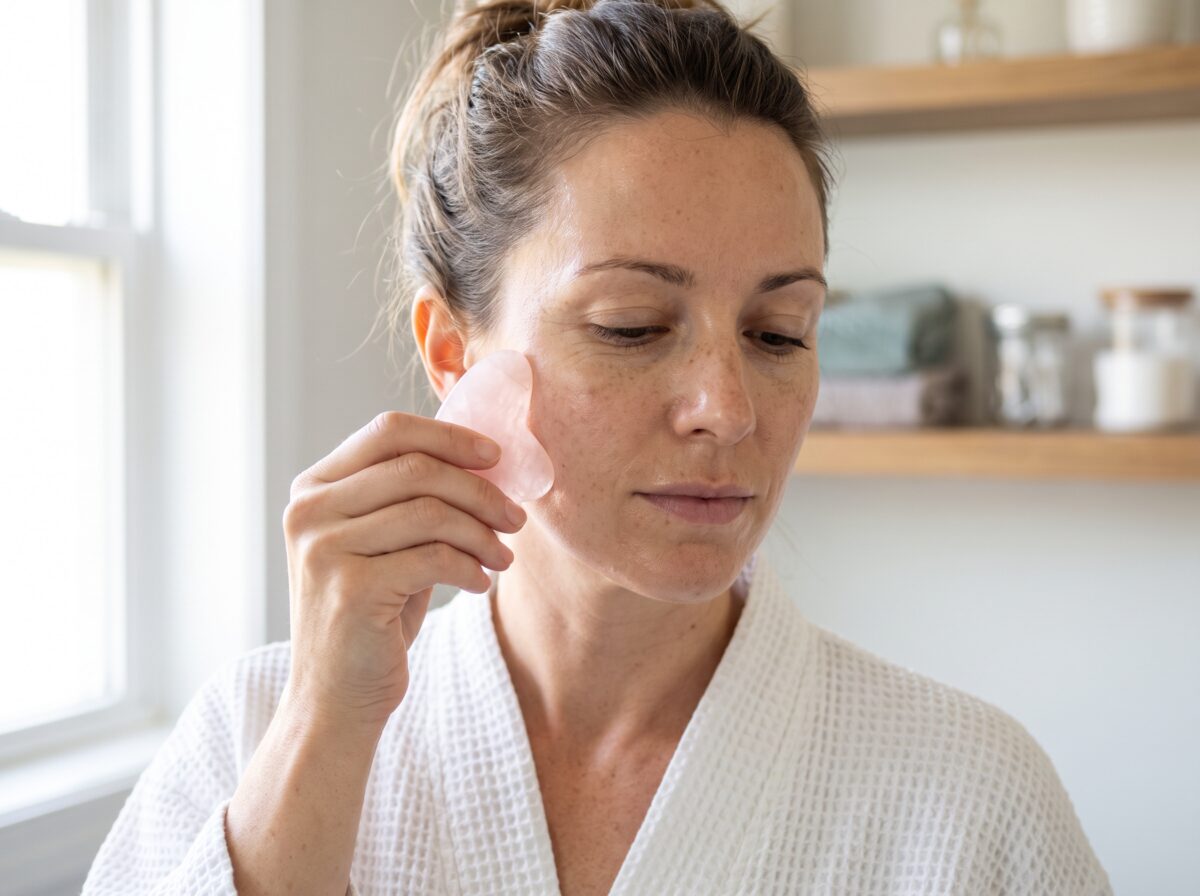
Gua sha comes from Traditional Chinese Medicine. For the face, the stone is glided over the skin with gentle pressure. What you see straight away: less morning puffiness, rosier skin, a more relaxed expression.
The effect comes from massage and lymph stimulation, not from the stone itself. That is why it only lasts briefly. For deep lifting or wrinkles it is not enough; there are other methods for that, such as professional facial massage.
💧 Less puffiness · ✨ Fresher complexion · 🧘 Relaxation
Important to know
There are no reliable studies proving lasting lifting from gua sha. The positive effect is mainly due to the massage. Treat promises of “a new face instantly” with caution.
Rose quartz, jade or stainless steel: which stone suits you?
Materials
Honestly: technique matters more than material. Still, there are differences.
Rose quartz and jade feel pleasant and stay cool for longer, but are more porous and harder to keep clean.
Stainless steel is hygienic, stays cold for a long time and is easy to clean, the most practical choice for many.
🌸 Rose quartz · 🌿 Jade · 🪞 Stainless steel
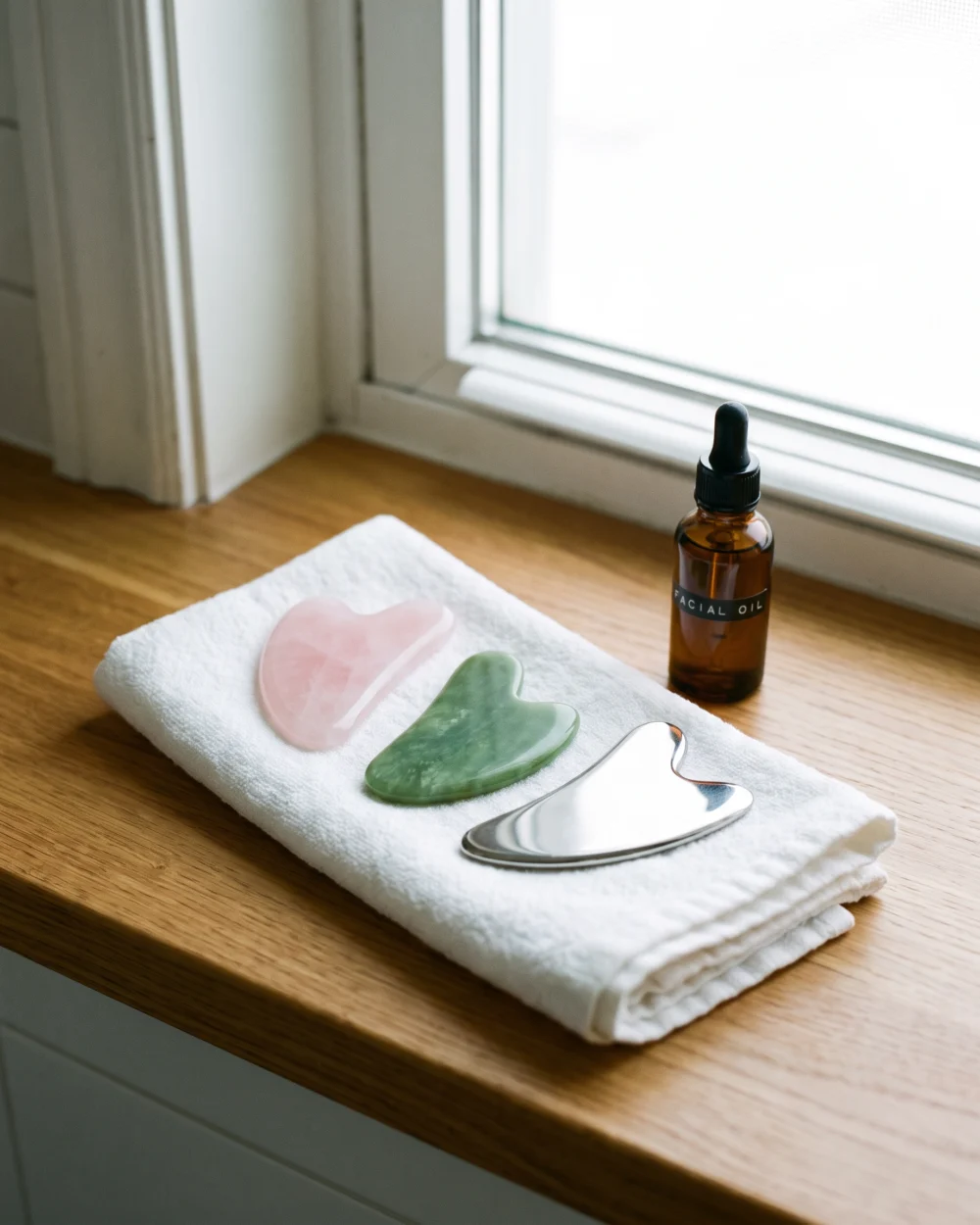
| Material | Advantage | Disadvantage |
|---|---|---|
| Rose quartz | Beautiful, smooth, cooling | Can develop hairline cracks |
| Jade | Pleasant in the hand | Authenticity hard to verify |
| Stainless steel | Hygienic, durable, very cold | Feels less “natural” |
Guide: gua sha step by step
How it works
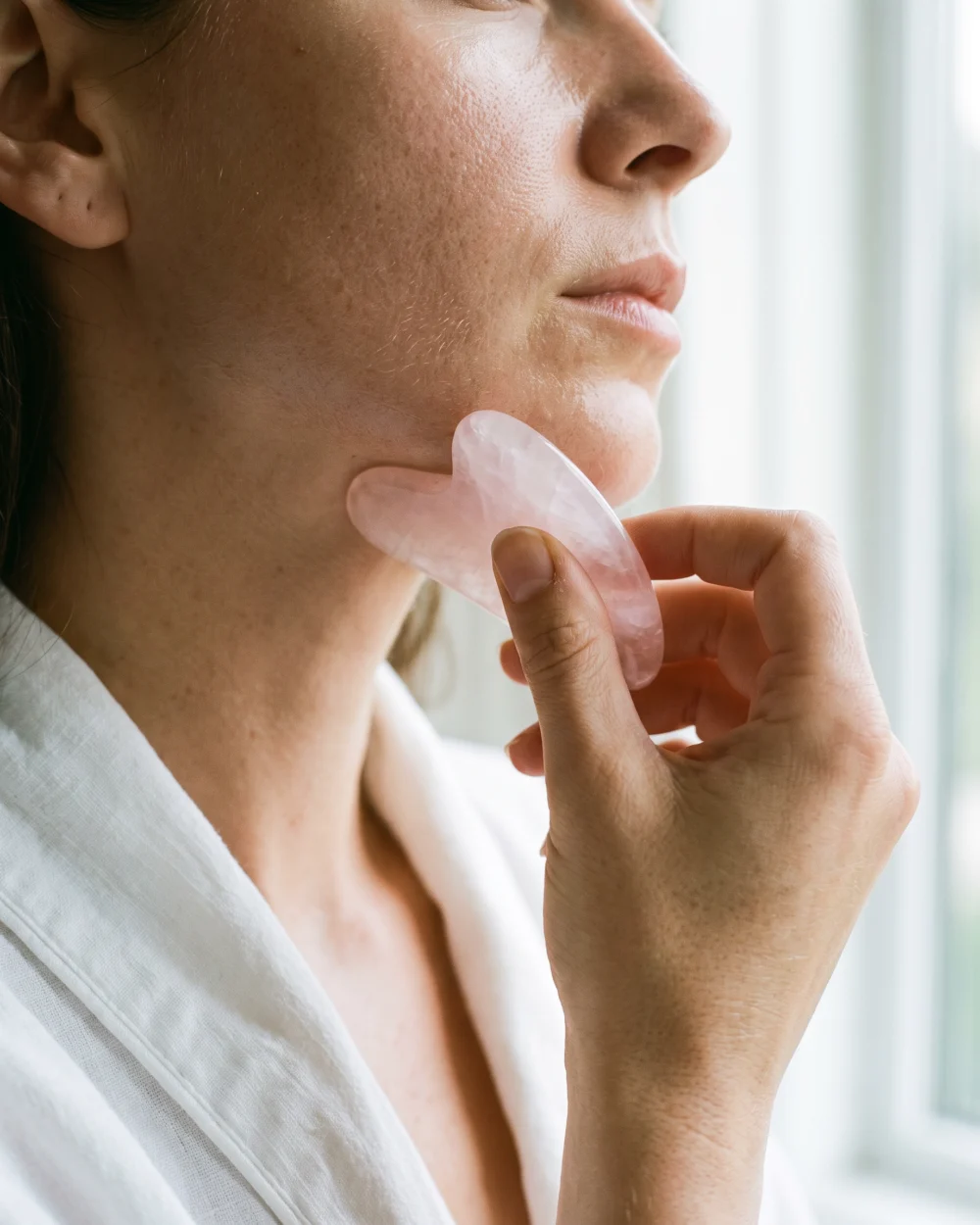
Preparation: cleanse your face, then apply a facial oil or a slippery cream. Without a glide the stone drags on the skin.
Angle: hold the stone very flat, about 15 degrees to the skin, and apply only light pressure.
Direction: always from the inside out and from the bottom up. Repeat each movement about five times.
⏱ 5–10 minutes · 📅 3–5× per week · 💧 Always with oil
And this is the order:
- Neck: gently stroke from the collarbone towards the jaw to prepare the drainage.
- Jaw and chin: from the chin along the jawline to the ear.
- Cheeks: from the nose to the ear, then to the temple.
- Eye area: very lightly from the bridge of the nose to the temple, along the bone, never on the eyelid.
- Forehead: from the centre outwards, then towards the hairline.
You can read more about how massage and lymph flow work together in our article on facial massage and lymphatic drainage. For the chin area, getting rid of a double chin without surgery is also worth a look.
The 5 most common mistakes
- Too much pressure: gua sha should glide, not press. Heavy pressure leads to broken capillaries and bruises.
- No oil or serum: the stone rubs and the skin gets irritated.
- Wrong direction: stroking downwards or against the lymph flow achieves little.
- Too long or too often: more than 10 minutes daily needlessly stresses the skin.
- Not cleaning the stone: oil residue and germs can promote breakouts.
When you should skip gua sha
Gua sha is not suitable for every skin. Skip it with:
- Acne with inflamed pustules: the friction can spread bacteria and worsen the inflammation.
- Rosacea and couperose: pressure and warmth can trigger flare-ups, more in our article on couperose vs. rosacea.
- Perioral dermatitis: friction and oil are counterproductive here, see our guide on perioral dermatitis.
- Sunburn, open wounds or fresh treatments such as peels or microneedling.
- Blood thinners or thrombosis: clarify with a doctor first.
Cleaning and caring for the stone
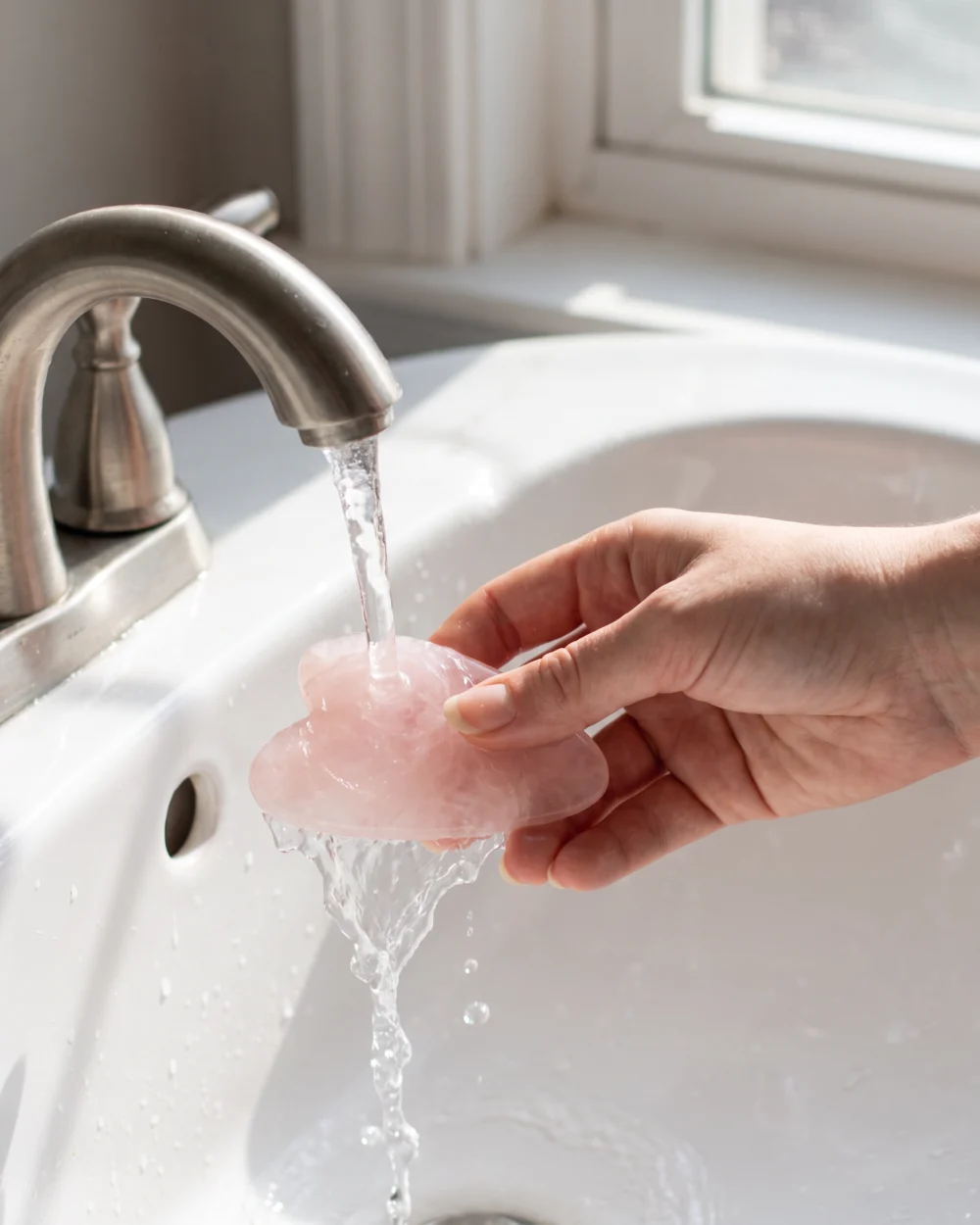
Hygiene
After every use, wash the stone with warm water and mild soap and pat it dry. About once a week you can wipe it with alcohol (70 %).
Store it dry and protected so that nothing chips. Replace it if it cracks, because cracks trap germs and can injure the skin.
🧼 After every use · 💧 Store dry · ⚠️ Cracks = replace
How to find out what your skin really needs
Gua sha is a nice ritual, but not a treatment plan. If you really want to change something, an analysis of your skin helps. We tell you honestly what makes sense for you, and what does not.
1
Book an appointment
Book online – your skin analysis is completely free.
2
Skin analysis
We assess skin type, hydration, pores & pigmentation.
3
Get your plan
You get an honest recommendation – no obligation.

✦ 100 % free
Your free skin analysis in Munich
Take the first step towards your dream skin. Together we find exactly the method that suits you, with or without gua sha.
- Professional assessment of your skin type
- Honest, personal treatment recommendation
- Tips for your home care
- No obligation & no pressure to buy
FAQ about gua sha
How often should I use gua sha?
Three to five times a week for 5 to 10 minutes is plenty. More brings no extra benefit and can irritate the skin.
Does gua sha help against wrinkles?
Not provably. In the short term skin looks plumper and fresher, but deep wrinkles do not disappear.
Can gua sha lift the face permanently?
There is no reliable evidence for that. The effect is based on massage and lymph stimulation and lasts only briefly.
Is gua sha suitable for acne?
Better not on inflamed skin. On calm skin it is fine if the stone is clean and you apply only light pressure.
Do I definitely need oil?
Yes, or another glide such as a serum. Without a glide film the stone drags on the skin and irritates it.


